Artistic research
Bogdan Szyber
Forty-five years of site-specific performance practice, and six years of doctoral research into what that practice becomes once the academy takes charge of it.
The enquiry
Art has almost no general public interest. It becomes a public event only at the moment it presents itself as something other than art.
That proposition has organised my work since the early 1980s, long before I had a vocabulary for it. The method has been consistent: build a situation in a real place, at real scale, with real people, and withhold the frame that would let an audience file it as art. What the situation then produces — belief, outrage, retraction, administrative response — is the material.
From 1980 to 2024 that work was made with Carina Reich as the company Reich+Szyber: just over ninety productions, from mud tanks and drownings on small stages to opera houses, castle parks, water towers, bomb shelters and lighthouses. The complete catalogue, with dates, venues and collaborators, is documented at reich-szyber.com.
Between 2014 and 2020 I turned the same method on the institution that had begun to host it. That enquiry became Fauxthentication.
Doctoral research, 2014–2020
- Title Fauxthentication — Art, Academia & Authorship (or the site-specifics of the Academic Artist)
- Institution Stockholm University of the Arts (SKH/Uniarts), Faculty of Performing Arts
- Defended 15 May 2020, in a defence streamed live
- Opponent Sinziana Ravini
- Deposited National Library of Sweden (LIBRIS) · DiVA · Research Catalogue
- Downloads Approximately 11,000 to date
The project investigated the means of production of art made inside the boundaries of artistic research: what constitutes its value system, who or what is permitted to produce signs of that value, and for what reasons. It proceeded by institutional critique, critical intervention and site-specific case studies rather than by commentary.
The case studies tested the boundary in practice. I purchased art production online and had it delivered. I engaged a composer in Los Angeles and staged her performance to her instructions, inside the university. I exhibited ten per cent of all doctorate-holding artistic researchers in Sweden at the Swedish History Museum. Each case asked the same question from a different side: at what point does labour performed by someone else, somewhere else, become the researcher's own contribution to knowledge.
The examining committee failed the thesis unanimously. It was the first artistic doctoral thesis to be failed in Sweden. The work remains deposited and publicly available in full.
The decision was followed by sustained national debate in the Swedish press, a documentary by Swedish public television, and, in 2026, the Lars Vilks Stipend, awarded principally for the doctoral project. The thesis has been downloaded some eleven thousand times. I have not revised it. The argument it makes about the conditions of artistic research is the argument I would defend.
Concepts developed
-
fauxthentication
The manufacture of authenticity as a tradeable sign — and the market that rewards it across art, academia and publishing alike.
-
edu-art · edu-art-ism
Art produced to satisfy the conditions of academic assessment, and the self-referential idiom it hardens into once quality is judged chiefly through theoretical framing.
-
the site-specifics of the academic artist
The university read as a site in the site-specific sense: a place with its own architecture, rituals, economy and audience, which shapes any work made inside it.
-
desengaño
Disillusionment as a method rather than a mood — the deliberate removal of a frame the audience has been relying on.
-
genius loci and displacement
What a place already carries, and what happens to a body placed where it does not belong.
-
the znachor
The folk healer or charlatan: a figure whose authority is granted entirely by the belief of those who consult him.
Selected works carrying the enquiry
- 1985
Eaten by Men
Stage work. Photograph: Jan Rüsz.
- 1989
Beautiful Sadness
Site-specific work beneath a motorway viaduct. Photograph: Anders Thessing.
- 1990
Falcon Crest
Stage work with mud tank and falling water. Photograph: Helene Schmitz.
- 2008
Music for a Darkened Theatre
With Cecilia Roos and Göran Svalberg. Photograph: Mats Bäcker.
- 2012
Drottninggatan
Thirty-six people were paid to spend a day begging on Stockholm's principal shopping street. Swedish public radio reported the scene as news, then retracted its own report on learning the participants were employed. The retraction, not the action, is the finding.
- 2014–20
Fauxthentication case studies
Purchased art production; a commissioned composer staged to her own instructions; ten per cent of Sweden's doctorate-holding artistic researchers exhibited at the Swedish History Museum.
- 2024
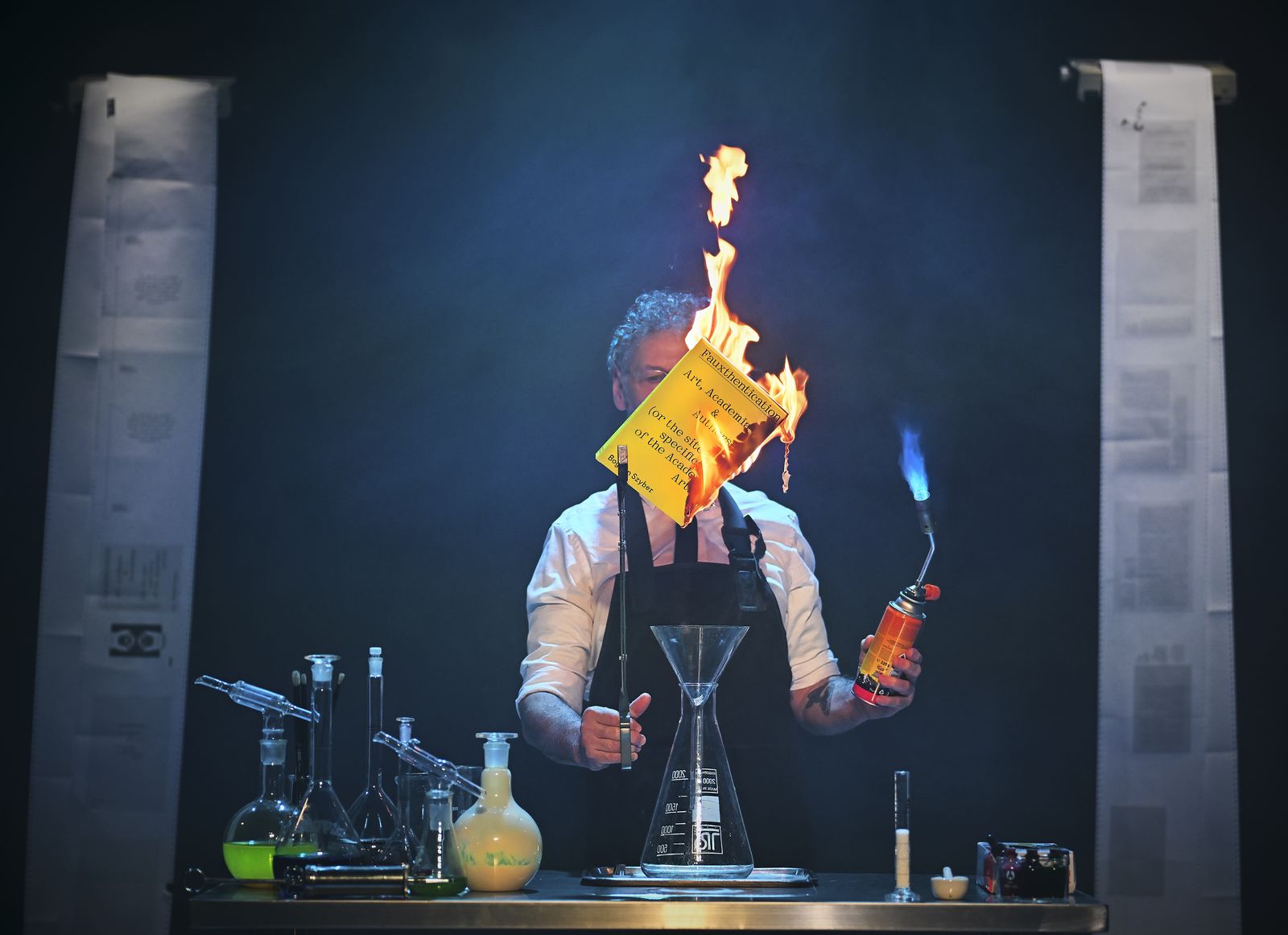
Fool's Errand: an Alchemical Sonata
Performance at Konträr, Stockholm. Nine copies of the thesis were ritually burned, and the ash baked and eaten.
- 2024
Mr Gloom
Solo performance work.
Dissemination and reception
- Documentary Fallet Bogdan — konstnären som underkändes (“The Bogdan Case — the artist who was failed”), Swedish public television
- Award Lars Vilks Stipend, 2026 — awarded principally for the doctoral project
- Book Yrsel — en litterär performance, Fri Tanke, Stockholm, 2026. A memoir of the practice and the doctoral process. In Swedish; description and publication details in English.
- Commission Essay for Kvartal on Lars Vilks and Swedish artistic life, 2026
- Reviews Svenska Dagbladet (Gunilla Kindstrand); BTJ no. 20, 2026 (Matilda Nilsson, rated 5 of 5); Svensk Tidskrift (Katarina O’Nils Franke) — quoted in English
- Archive Full catalogue of works, 1984–2024, at reich-szyber.com and in Scenarkivet
Background
Born 1958 in Zabrze, Poland, of Polish-Ukrainian-Jewish descent; came to Sweden at the age of eleven. Trained in mime at Danshögskolan, Stockholm.
At twenty I spent a year at Friedrichshof in Austria — Otto Muehl's AAO commune, in the lineage of Viennese Actionism — followed by EST and other self-development movements. Those years are not biography attached to the work; they are the first fieldwork in it. Each was an organised apparatus for the production of authenticity, entered from the inside, and the questions they raised are the ones the doctoral project put to the university thirty-five years later.
Contact
- Email [email protected]
- Thesis Available in full, National Library of Sweden
- Archive reich-szyber.com