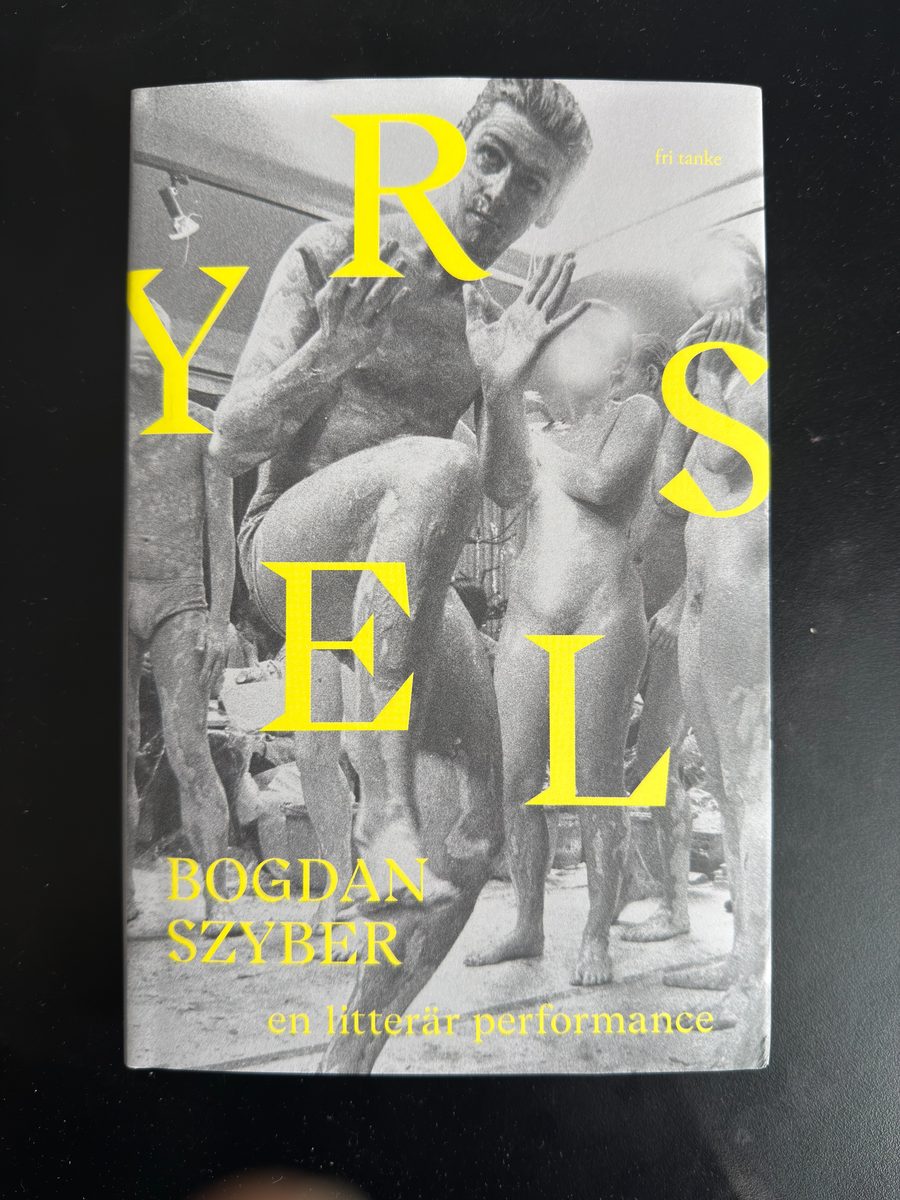
The book
Dolly Zooma literary performance
Published in Swedish as Yrsel
Fri Tanke förlag, Stockholm, 25 August 2026
The publisher's description
The hunger for the authentic is insatiable. The novelist sells his private life, the performing artist puts ordinary people on stage, the programme note assures us that everything is based on real events. As though the invented no longer held any truth value.
For half a century Bogdan Szyber has made performance art in the borderland between authenticity and pretence. He used the same methods in his doctoral thesis to criticise the truth claims of artistic research — and was failed. The defence gave rise to an extensive debate in Sweden.
The book is the story of a life on the stages of the Swedish art world, from the shadows of the Holocaust and the lure of the cults to the hidden power games of the institutions. It is autofictional authenticity literature, signed by the artist who distrusts the authentic. It is the truth — or his most calculated staging yet.
The author's account
Written for the Swedish book-trade journal Svensk Bokhandel, in its series on the debut authors of autumn 2026.
For over forty years I have buried myself in forest soil on estates in Skåne, dipped myself in molasses, mimed toilet stops for Maori children in New Zealand, staged operas at Norrlandsoperan and Folkoperan, made performances at the Royal Dramatic Theatre and in Belarusian parks. Together with my colleague Carina Reich I have made art that by definition disappears in the same moment it is performed.
None of it gave me my largest media breakthrough.
That came instead in the spring of 2020, when I became the first person in Sweden to have an artistic doctoral thesis failed. My thesis Fauxthentication questioned the conditions of production in artistic research and coined the term “edu-art”. The examining committee failed me unanimously, in a defence streamed live. In 2024 I burned the thesis, baked a cake from the ashes and ate it at Teater Konträr. Then came the Swedish public television documentary Fallet Bogdan (“The Bogdan Case”) and a fresh wave of debate washed through the culture pages. There is a certain irony in a failed work generating more public interest than everything that passed.
I was born in Poland in 1958 and came to Sweden at the age of eleven. Polish-Ukrainian-Jewish background; my grandfather a field surgeon in the Tsarist Russian army; that entire generation wiped out. My father told it in fragments, on one memorable occasion while chewing pieces of tripe. You learn early that the truth does not arrive neatly packaged.
Perhaps that is why, at twenty, I ended up in the Austrian art and sex commune Friedrichshof — Otto Muehl's AAO — in search of another kind of authenticity. And then onward through EST, years of psychotherapy, forever searching for what the body already knew but the head refused to formulate. It turned into a long detour. Or perhaps the only road.
It took forty years of the art of the moment before the body was ready to sit down and write. The Swedish title, Yrsel, is also the Swedish title of Hitchcock's Vertigo, and it names the camera technique: a dolly zoom, where you zoom into the past while moving away from it. The background twists, the perspectives shift. You get dizzy. But you see more clearly.
Swedish reception
-
“An intelligent mix of case studies, autobiography, and debate on art and society.”
Gunilla Kindstrand, Svenska Dagbladet
-
“Szyber has taken on an almost impossible task: to render in letters something as fleeting as performance. It is brilliantly done, from the inside.”
Matilda Nilsson, BTJ no. 20, 2026 · rated 5 of 5
-
“That rare thing: a book that manages to be self-exposing, intellectual and entertaining at the same time.”
Katarina O’Nils Franke, Svensk Tidskrift
An extract from the book appeared in Kvartal in September 2026, and the Swedish daily Dagens ETC ran an interview with the author in October. Quotations above are translated from the Swedish.
Publication details
- Swedish titleYrsel — en litterär performance
- English working titleDolly Zoom — a literary performance
- AuthorBogdan Szyber
- PublisherFri Tanke förlag, Stockholm
- Published25 August 2026
- LanguageSwedish
- FormatHardback, 120 × 185 mm
- ISBN9789189961999
- Cover designStudio Liljemärker
- Author photographsMikael Lundblad
- RightsFri Tanke förlag
- Publisher pagefritanke.se
- The thesisFauxthentication, in full, National Library of Sweden
- Enquiries[email protected]